
Introduction
 In April 2026, the COBIT framework celebrated its 30th anniversary. Launched in 1996 by ISACA, this framework—originally named Control Objectives for Information and Related Technology—has profoundly transformed corporate information technology (IT) governance. From a simple IT audit tool, it has evolved into a comprehensive corporate IT governance system for digital operations.
The historical evolution of the framework
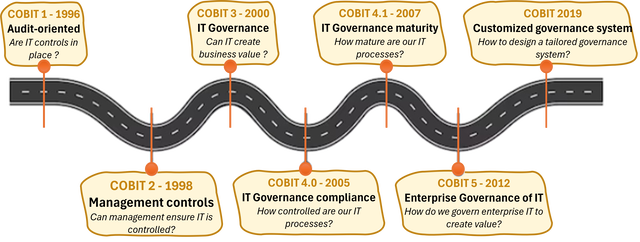
COBIT’s journey over three decades reflects the changes in the global IT landscape:
- 1996 (COBIT 1): Focused on IT controls for financial reporting reliability.
- 1998 (COBIT 2): The framework expanded to include management controls for a better alignment with business needs.
- 2000 (COBIT 3): Formal concept of IT Governance through business-IT alignment and performance measurement .
- 2005 / 2007 (COBIT 4 / 4.1): Integration of maturity models to measure process performance.
- 2012 (COBIT 5): A comprehensive framework clearly separating governance (strategy, direction) from management (execution), facilitating the alignment of overall enterprise strategy with IT strategy.
- 2018 (COBIT 2019): Current version introducing ‘design factors’ to enable organisations to implement a tailor-made governance system.
Key lessons from COBIT
After 30 years of practice, three fundamental pillars are identified:
- Governance is distinct from management: Governance sets the direction and assesses risks; Management carries out day-to-day operations.
- Value stems from decisions: Technology alone produces no value; it is the way in which it is aligned with business strategy that generates benefits.
- A tailor-made tool: COBIT is not applied rigidly as a one-size-fits-all solution. Each organisation must adapt it to its size, risk profile and sector.
Future challenges: The age of artificial intelligence
In 2025, ISACA released guidance on using COBIT to govern Artificial Intelligence (AI). ISACA highlights the framework’s flexibility in defining accountability, transparency and decision-making rights regarding algorithms, thereby sparing organisations the need to reinvent new models with every technological disruption.
More information
Discover the ISACA announcement

 Patrick Soenen: +32 477 75 78 61
 info[at]qap.eu